Share this page!
When are the planets aligning in 2026? Use our display to see when the planets align through out the year and when it’s a good idea to start looking up and take it all in!
The astronomical event of the decade is here. A rare planetary alignment brings Mercury, Venus, Mars, Jupiter, Saturn, Uranus, and Neptune into a stunning celestial parade. This guide shows you exactly when to look up, which planets are visible to the naked eye, and how to capture this historic moment before the orbits shift. Whether you are a seasoned stargazer or a casual observer, this is the night the solar system puts on a masterpiece.
Support us by subscribing to our YouTube Channel!Subscribe here!
Celestial Observer
March 5, 2026
RARE PARADE: 4 PLANETS
-2 Years Current Timeline +2 Years
Relative Observation●Mercury 355.2°
●Venus 353.6°
●Mars 331.1°
●Jupiter 77.5°
●Saturn 358.2°
Geocentric Sync: Calculates planet positions relative to Earth. The green indicator lights up when 3+ planets occupy the same sector of our sky.
Will you be watching the alignment? Join our community to see photos from other stargazers or get help finding the planets from your specific location!
Planetary Alignment Guide 2026: Physics, Phasing, and Observation
Planetary alignments, colloquially known as “planetary parades,” are among the most visually striking phenomena in observational astronomy. To the casual observer, they appear as a rare, disciplined line of “stars” across the twilight sky. However, from an astrophysical perspective, an alignment is a complex 3D syzygy that reveals the flat, disk-like structure of our Solar System.
At SpaceInformer, our live planetary tracker calculates the current heliocentric longitudes of the planets to provide an accurate “top-down” view. This guide dives deep into the mechanics of these events and how to document them in 2026.
The Geometry of the Ecliptic Plane
To understand why planets align, one must visualize the Ecliptic. The Solar System formed from a spinning protoplanetary disk roughly 4.6 billion years ago. Because of this, nearly all planets orbit within a few degrees of the same plane.
When we observe an alignment, we are essentially looking “edge-on” at this cosmic plate. While the planets are millions of miles apart in depth, their celestial longitude converges from our vantage point on Earth. A “perfect” alignment is physically impossible due to the slight orbital inclinations (for example, Mercury is tilted 7 degrees relative to Earth’s orbit), but they frequently cluster within a 15 degrees to 30 degrees sector of the sky.
2026 Observation Windows: The “Big Three” Events
The year 2026 is an exceptional period for multi-planetary gatherings. Our orbital models highlight three specific windows where the visual density of planets will be at its peak:
The Pre-Dawn Trio
This event features Mars, Jupiter, and Saturn. The expertise tip here is to look for the “Color Contrast.” Mars will exhibit a distinct ochre-red hue, while Jupiter will be the dominant brilliant white light. Saturn, slightly dimmer and more yellowish, will sit between them.
Best Viewing: 45 minutes before sunrise. Equipment: Naked eye for the alignment; 8×42 binoculars to see Jupiter’s Galilean moons.The Sunset Quadrant (August 12, 2026)
A rare grouping of Mercury, Venus, Mars, and Jupiter. This is a challenging observation because Mercury and Venus will be very low on the horizon.
Expert Advice: You must have a completely flat Western horizon (such as a coastline or open field). Atmospheric extinction will dim the planets as they sink lower into the thickest part of Earth’s atmosphere.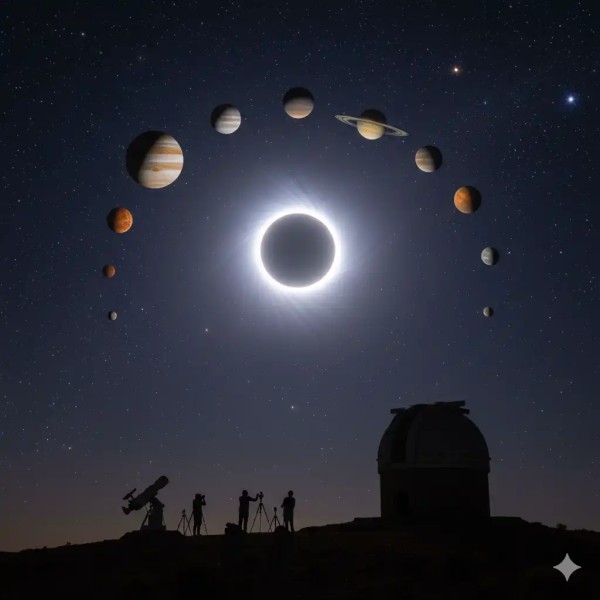
The Autumn Parade (November 2026)
A five-planet mini-parade. While spread further apart, the line will stretch across a large portion of the sky, providing a literal map of the Ecliptic plane.
Expertise: How to Distinguish Planets from Stars
Scintillation (Twinkling): Stars are point sources of light; their light is easily distorted by Earth’s turbulent atmosphere. Planetary Disks: Planets are closer and appear as tiny disks (even if they look like points to you). This “width” makes their light more stable. If a “star” isn’t twinkling, it is almost certainly a planet. The Magnitude Scale: Use our tracker to check the Apparent Magnitude. Venus often hits $-4.4$, making it bright enough to cast a subtle shadow in extremely dark locations.Astrophotography: Capturing the Parade
Documenting an alignment requires more than just pointing a smartphone. To capture the full “parade” in one frame:
Wide-Angle Lenses: Use a focal length between 14mm and 24mm to capture the entire span of the alignment. The Rule of 500: To avoid “star trails” (blurring caused by Earth’s rotation), divide 500 by your focal length to find your maximum exposure time in seconds. Blue Hour: The best photos are taken during the “Blue Hour”—the period of twilight when there is still enough light to see the landscape, but the planets are bright enough to pop.Does a planetary alignment exert gravitational stress on Earth?
This is a common “pseudoscience” concern. While planets are massive, the Inverse Square Law of Gravity dictates that their distance renders their pull on Earth negligible. Even when all planets align, their combined gravitational effect is less than 1/100th of the Moon’s daily tidal pull.
What is a “Great Alignment”?
A Great Alignment is a rare event involving all five planets visible to the naked eye (Mercury, Venus, Mars, Jupiter, and Saturn). These occur roughly every 18 years. The last one was in June 2022, and the next will not occur with such clarity until the 2040s.
Why do planets sometimes appear to move backward during an alignment?
This is known as Apparent Retrograde Motion. Because Earth orbits the Sun faster than the outer planets, we occasionally “lap” them. It’s like passing a slower car on the highway—from your perspective, the other car looks like it’s moving backward.
How do I find the Ecliptic line if I can’t see all the planets?
Look for the Moon! The Moon also follows the Ecliptic plane. If you draw an imaginary line from the Moon through a visible planet like Jupiter, that line is the path where the other hidden planets will eventually rise or set.
Is Pluto part of these alignments?
Technically, yes, but not for the naked-eye observer. Pluto is nearly 1,000 times dimmer than the faintest star visible to the human eye. To include Pluto in your “alignment” experience, you would need a 12-inch aperture telescope and dark sky conditions.

